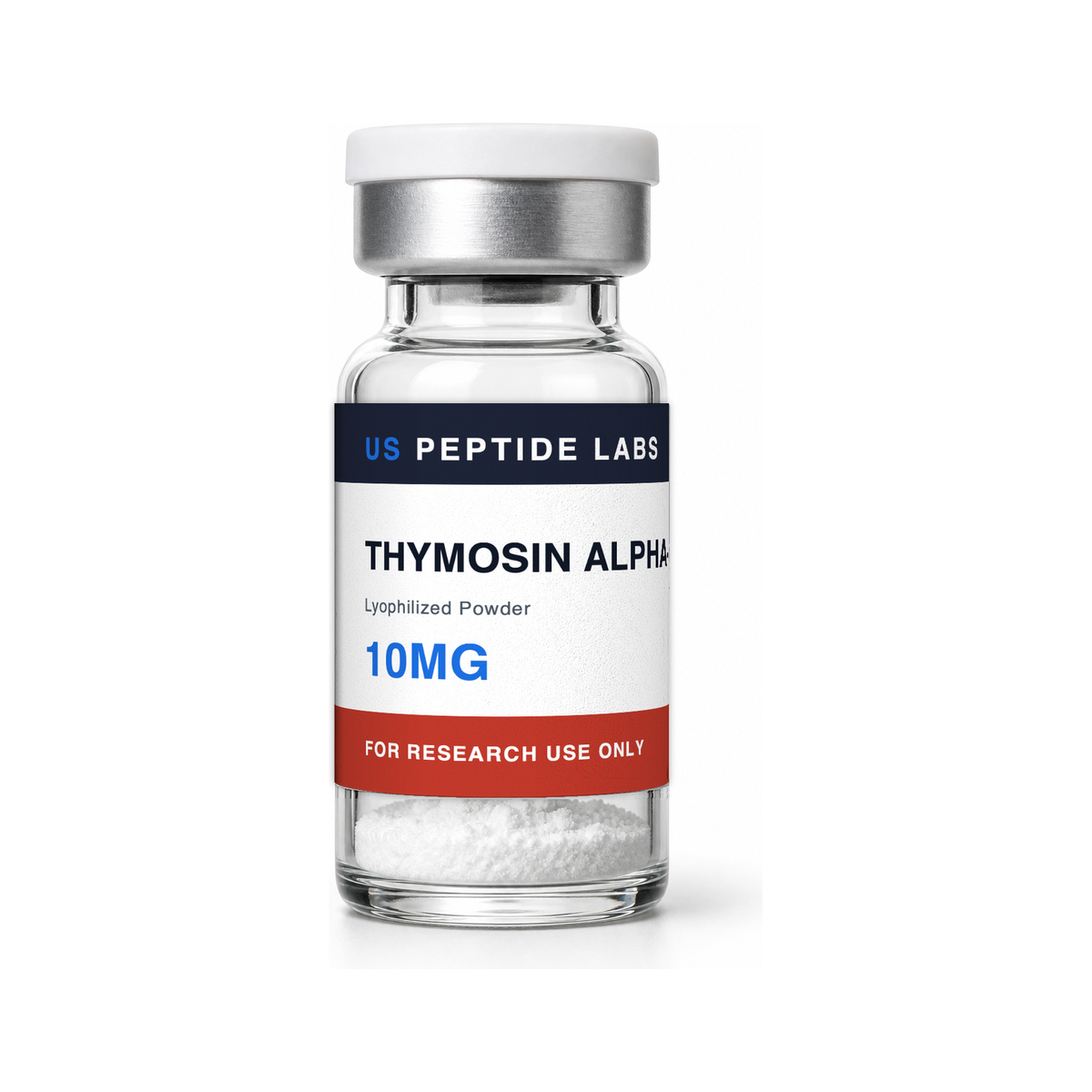
Vial products ship as dry lyophilized material unless the product format explicitly states otherwise.
10mL Vial99%+ PurityAnti-Aging & Longevity
10mL Vial
Thymosin Alpha-1
Immune-modulating research peptide
$118.00
Volume pricing
Per-unit price drops automatically as quantity increases.
| Strength | 1 | 2+ | 5+ |
|---|---|---|---|
| 10mg | $118.00 | $112.10 | $106.20 |
Per-unit pricing at each quantity break, applied automatically at checkout.
Immune-modulating research peptide
Lot documentation
Certificate of Analysis
Your lot number is stamped on the base of the vial or bottle. Match it to the list to open the certificate for the exact material you received.
- Lots on file
- 3
- Laboratory
- AxisPharm, LLC
What the literature reports
Thymosin alpha-1 is a thymic peptide studied as an immune modulator in oncology, viral infection, and vaccine-adjuvant clinical and translational research settings.
-
In patients with non-small cell lung cancer after radiotherapy, synthetic thymosin alpha-1 accelerated reconstitution of T-cell functional measures in a randomized schedule-comparison study.
-
In a severe COVID-19 cohort, thymosin alpha-1 use was associated with higher blood T-cell counts and lower observed mortality than contemporaneous untreated comparators.
-
In a randomized trial in chronic hepatitis B, thymosin alpha-1 was associated with higher rates of HBV DNA clearance and ALT normalization versus untreated controls.
These summaries describe findings reported in published laboratory and clinical literature about this compound. They are provided for research context only. They are not claims about this product, and nothing here describes an intended use in humans or animals. This material is supplied strictly for laboratory research use.
Technical documentation
About Thymosin Alpha-1
Technical overview
Thymic immunomodulatory peptide
Thymosin alpha-1 (Tα1) is a 28-amino-acid peptide originally isolated from thymic tissue and later produced synthetically. It has been investigated for decades as an immunomodulatory molecule that can influence T-cell maturation, dendritic-cell function, and innate immune signaling. In some countries a pharmaceutical form (thymalfasin) has been used clinically; that regulated product context is separate from bulk research-grade peptide supply.
The research literature spans viral immunology, sepsis adjunct models, vaccine-response biology, and cancer-immune interaction studies. Reviews summarize a large cumulative clinical-trial footprint and generally describe a favorable tolerability profile in studied settings, while also noting heterogeneity of indications and study quality.
Research-grade thymosin alpha-1 is Research Use Only. It is not an FDA-approved U.S. drug product for general therapeutic marketing in this RUO context, and it is not for human consumption. Dosage figures below are literature references for education only.
Mechanism of action
Tα1 interacts with innate immune pattern-recognition pathways, including Toll-like receptor-related signaling in dendritic cells and other antigen-presenting cells. Downstream effects reported in the literature include enhanced T-cell differentiation and function, modulation of cytokine patterns, support of NK-cell activity, and context-dependent restoration of immune competence in suppressed states. It is better described as a multi-node immune modulator than as a single-receptor hormone mimetic.
Research applications
- T-cell and dendritic-cell immunology
- host defense and viral immunology
- sepsis and critical-illness immune tone
- vaccine adjuvant biology
- cancer-immune interaction models
Fields of active investigation, not claims. Investigation is not proof.
Immunologists, infectious-disease researchers, and translational oncology groups are the primary audience. Additional work appears in aging-immunity and vaccine-response laboratories interested in thymic peptide biology.
Amounts reported in the literature
What published research and laboratory protocols document. These describe what was studied — they are not instructions, recommendations, or a protocol for use.
| Reported amount | Frequency | Route | Research context |
|---|---|---|---|
| 1.6 mg – 3.2 mg | twice weekly | subcutaneous | Commonly cited thymalfasin / Tα1 research and clinical-literature exposure |
| 900 mcg – 1.6 mg | two to seven times weekly depending on protocol | subcutaneous | Alternate research schedules summarized in reviews |
Handling and storage
Keep lyophilized Tα1 cold, dry, and light-protected. After reconstitution, refrigerate and handle as a labile peptide according to the laboratory beyond-use protocol.
Notes on combined research
Research designs sometimes evaluate thymosin alpha-1 alongside antivirals, checkpoint-oriented oncology regimens, or other immune modulators when the question is host-response augmentation. It is mechanistically distinct from tissue-repair peptides such as TB-500, so combinations are usually immunology-driven rather than recovery-stack driven.
Analytical specifications
| Purity | ≥99.4% by HPLC |
|---|---|
| Format | 10mL Vial |
| Physical form | Lyophilized powder |
| Third-party laboratory | AxisPharm, LLC |
| Lots with COA on file | 3 |
| Also referred to as | Tα1, Thymalfasin, Thymosin α1 |
| Reported half-life | Short plasma half-life (on the order of hours) reported; biologic immune effects are studied over longer courses |
Identity and purity are documented per lot on the Certificate of Analysis for the material you receive. Lot, manufacture and expiry are stamped on the base of the vial or bottle.
Frequently asked questions
What is thymosin alpha-1 peptide dosage in the literature?
Many clinical and translational papers reference about 1.6 mg subcutaneously twice weekly for thymalfasin-style regimens. Other schedules exist; methods sections are the authoritative source.
Is thymosin alpha-1 the same as TB-500?
No. Thymosin alpha-1 is an immunomodulatory thymic peptide. TB-500 relates to thymosin beta-4 actin biology. They are different molecules with different research stories.
What does thymosin alpha-1 do in immune models?
Literature describes effects on T-cell maturation, dendritic-cell activation via innate receptors, cytokine balance, and host-defense readiness in suppressed or challenged states.
Is research-grade thymosin alpha-1 FDA-approved?
Research-grade material is RUO and not for human consumption. Pharmaceutical thymalfasin has been used in some countries under local regulatory frameworks, which is a separate product class.
Why do infectious-disease researchers care about Tα1?
Because multiple studies and reviews examine whether immune reconstitution or immune modulation with Tα1 changes host response in viral disease and sepsis models.
How is Tα1 usually supplied for laboratory work?
As lyophilized peptide in multi-milligram vials that are reconstituted before in vitro or in vivo experimental use.
Does a short half-life mean it cannot be studied chronically?
No. Many protocols use repeated dosing over weeks because immune endpoints accumulate across a course even when plasma residence time per dose is short.
References
Every reference below resolves to an indexed paper. We would rather cite less and cite accurately.
- Comprehensive Review of the Safety and Efficacy of Thymosin Alpha 1 in Human Clinical Trials.
- Thymosin alpha 1: A comprehensive review of the literature.
- Immune Modulation with Thymosin Alpha 1 Treatment.
- Thymosin alpha1 based immunomodulatory therapy for sepsis: a systematic review and meta-analysis.
Research use only
For laboratory and research purposes only. Not for human consumption, veterinary use, or medical applications. This product is not a drug, food, supplement or cosmetic, is not approved by the FDA, and is not intended to diagnose, treat, cure or prevent any disease. This page summarises published scientific literature; it is not medical advice and not a recommendation to use this compound. All handling must be performed by qualified personnel in a controlled laboratory environment.
Made in America. Documented lot by lot.
Most peptides sold in this category are imported in bulk, repackaged, and sold with no paperwork attached to the material in the bottle. Ours are synthesized in United States laboratories and every lot carries its own certificate.
Where is this material made?+
In United States laboratories. We buy from domestic synthesis rather than importing finished bulk from an overseas supplier and relabeling it. That is the reason we are able to name a specific laboratory, lot and test date for what you receive.
Why does a US laboratory matter?+
A domestic supply chain is shorter and documented end to end: identifiable facilities operating under US laboratory practice, and paperwork that follows one specific lot instead of a generic product description. It also means shorter transit and no repackaging between the laboratory and the customer.
What documentation comes with a lot?
A lot-specific Certificate of Analysis from an independent laboratory. The lot number is stamped on the base of the container — match it against the certificates listed on this page, or scan the QR code on the label, to open the report for the exact material shipped.
Where does my order ship from?+
Our United States facility, packed and dispatched domestically with tracking. Orders do not transit customs or get repackaged en route.