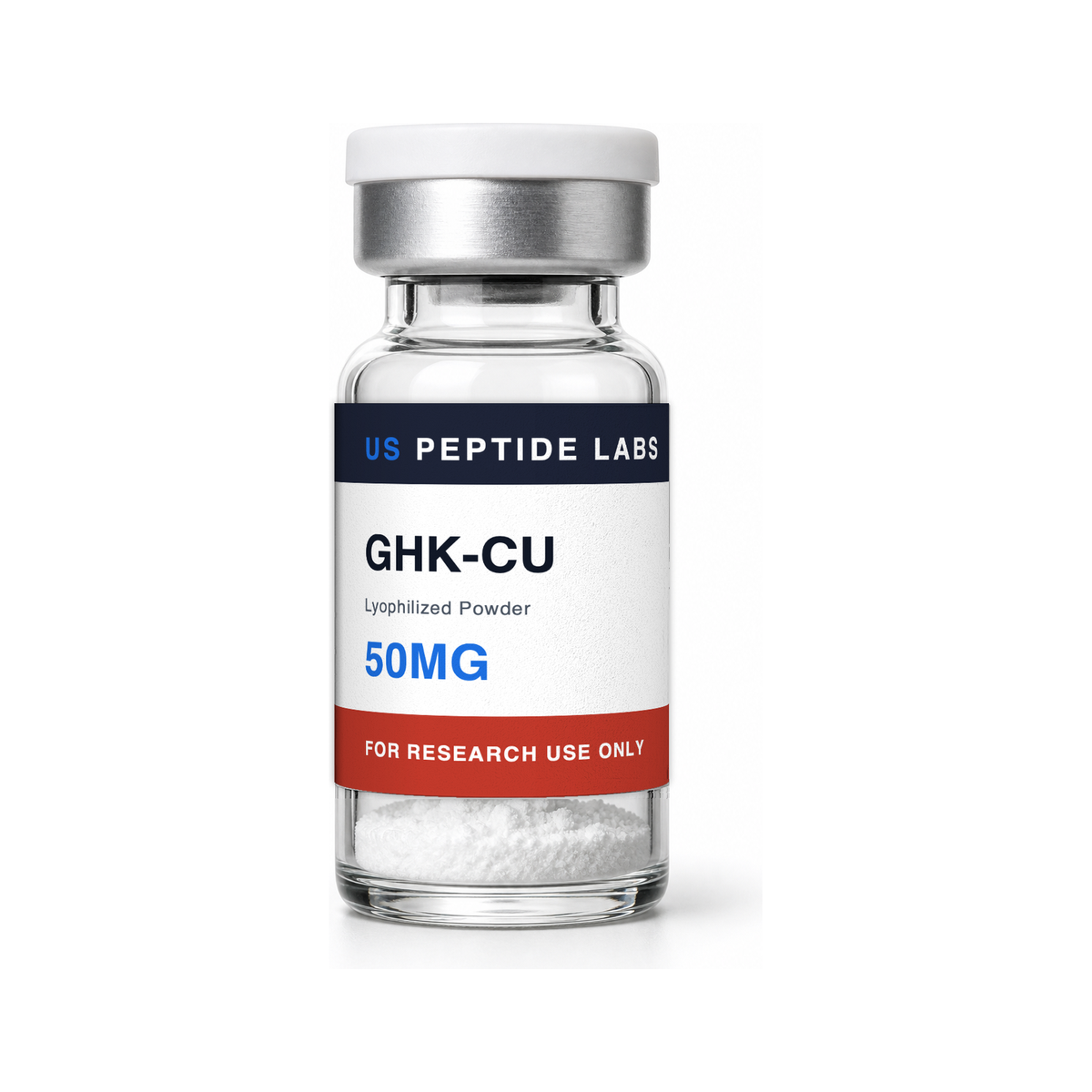
Vial products ship as dry lyophilized material unless the product format explicitly states otherwise.
10mL Vial99%+ PurityAnti-Aging & Longevity
10mL Vial
GHK-Cu
Copper peptide — skin, hair & regeneration research
$60.00
Volume pricing
Per-unit price drops automatically as quantity increases.
| Strength | 1 | 2+ | 5+ |
|---|---|---|---|
| 50mg | $60.00 | $57.00 | $54.00 |
Per-unit pricing at each quantity break, applied automatically at checkout.
Copper peptide — skin, hair & regeneration research
Lot documentation
Certificate of Analysis
Your lot number is stamped on the base of the vial or bottle. Match it to the list to open the certificate for the exact material you received.
- Lots on file
- 6
- Laboratory
- AxisPharm, LLC
What the literature reports
GHK-Cu is a copper-binding tripeptide complex studied in fibroblast cultures and tissue-remodeling models for effects on collagen synthesis and wound-related matrix responses.
-
In cultured fibroblasts, GHK-Cu stimulated collagen synthesis at nanomolar-range concentrations.
-
In rat wound-chamber experiments, the copper-GHK complex increased connective-tissue accumulation, including collagen and glycosaminoglycans.
-
Gene-expression analyses summarized by Pickart and colleagues describe broad remodeling-related transcriptional shifts after GHK exposure in human cell systems.
These summaries describe findings reported in published laboratory and clinical literature about this compound. They are provided for research context only. They are not claims about this product, and nothing here describes an intended use in humans or animals. This material is supplied strictly for laboratory research use.
Technical documentation
About GHK-Cu
Technical overview
Copper-binding tripeptide
GHK-Cu is the copper(II) complex of the tripeptide glycyl-L-histidyl-L-lysine. It appears in human plasma, saliva, and urine, and circulating levels are reported to decline with age. In research settings it is treated as a small signaling peptide that can shuttle copper into cells and influence gene programs tied to extracellular matrix turnover.
Investigators study GHK-Cu because multiple cell-culture and animal models link it to organized collagen and glycosaminoglycan synthesis, balanced matrix metalloproteinase activity, and support for angiogenesis during tissue remodeling. Reviews by Pickart and colleagues summarize effects across skin regeneration, wound models, and broader protective gene-expression patterns. Most human data involve topical cosmetic or dermatology formulations rather than large injectable trials.
For laboratory and research-use-only contexts, GHK-Cu is typically supplied as a lyophilized powder for reconstitution. Published work frames it as a reference compound for studying copper-dependent repair pathways, not as an approved systemic therapy for disease. Any dosage figures discussed on educational pages are literature-reported ranges for reference, not recommendations.
Mechanism of action
GHK binds Cu2+ with high affinity and can deliver bioavailable copper while acting as a signaling ligand. Reported cellular effects include modulation of TGF-beta and integrin-related pathways, upregulation of collagen, elastin, and proteoglycan synthesis, and coordinated control of MMPs and their inhibitors so matrix breakdown and rebuild stay balanced. Antioxidant and anti-inflammatory actions are also described, including support for superoxide dismutase activity and reductions in selected pro-inflammatory cytokines in experimental systems. Together these actions position GHK-Cu as a remodeler of the extracellular matrix rather than a simple structural filler.
Research applications
- skin remodeling
- wound healing
- extracellular matrix biology
- collagen synthesis
- anti-inflammatory signaling
- angiogenesis
Fields of active investigation, not claims. Investigation is not proof.
Dermatology and wound-healing researchers use GHK-Cu to probe copper-dependent matrix remodeling and fibroblast behavior. Cosmetic scientists evaluate topical formulations for photoaging and barrier metrics. Regenerative-biology labs study its gene-expression footprint in repair models. Interest is strongest among groups working on tissue architecture, not general endocrinology.
Amounts reported in the literature
What published research and laboratory protocols document. These describe what was studied — they are not instructions, recommendations, or a protocol for use.
| Reported amount | Frequency | Route | Research context |
|---|---|---|---|
| 500 mcg – 2 mg | daily | subcutaneous | Commonly cited in research and compounding reference protocols for subcutaneous investigation |
| no single figure reported | 1-2 times daily | topical | Topical dermatology and cosmetic research formulations |
Handling and storage
Keep lyophilized vials refrigerated or frozen per supplier COA, protected from light and moisture. After reconstitution with bacteriostatic water, refrigerate and use within the stability window stated by the supplier, commonly cited as up to 30 days when kept cold and uncontaminated.
Notes on combined research
In research catalogs GHK-Cu often appears alongside BPC-157 and TB-500/thymosin beta-4 in multi-peptide repair blends (for example Glow or Klow) because the components target complementary matrix, angiogenic, and inflammatory pathways. It is also studied next to topical retinoids or growth-factor serums in dermatology work. Stacking discussions should stay per-component: each peptide has its own concentration math.
Analytical specifications
| Purity | ≥99.1% by HPLC |
|---|---|
| Format | 10mL Vial |
| Physical form | Lyophilized powder |
| Third-party laboratory | AxisPharm, LLC |
| Lots with COA on file | 6 |
| Also referred to as | Copper Peptide, GHK-Copper, Copper tripeptide-1, Glycyl-L-histidyl-L-lysine copper |
| Reported half-life | Short systemic half-life reported for the free peptide (on the order of minutes to about an hour in secondary sources); topical residence depends on vehicle |
Identity and purity are documented per lot on the Certificate of Analysis for the material you receive. Lot, manufacture and expiry are stamped on the base of the vial or bottle.
Frequently asked questions
What is the dosage for GHK-Cu peptide?
There is no single universal clinical dose for research-grade GHK-Cu injectables. Secondary research-protocol summaries commonly cite roughly 500-2,000 mcg (0.5-2 mg) subcutaneously per day, while topical work uses percent-strength creams rather than mcg injections. Treat published figures as reference ranges from literature and lab practice, not personal medical advice. Use a reconstitution calculator to convert vial milligrams and diluent volume into mcg per unit.
How much bac water for GHK-Cu?
Common research vial sizes are 50 mg or 100 mg. Adding 3 mL or 5 mL of bacteriostatic water are frequent choices because they yield easy insulin-syringe math. Example: 50 mg in 5 mL gives 10 mg/mL, so 0.1 mL (10 units on a U-100 syringe) equals 1,000 mcg. Always confirm your vial label and calculate from actual mg and mL.
GHK-Cu dosage per day
Daily subcutaneous amounts most often discussed in research-protocol writeups fall near 1 mg/day, with a broader cited band of about 0.5-2 mg. Frequency is usually once daily in those summaries. Human injectable dose-finding literature is thinner than the topical evidence base, so ranges should be read as commonly reported reference values.
Is there a GHK-Cu dosage chart?
A practical chart maps reconstituted concentration to syringe units. If a 50 mg vial is mixed with 5 mL bac water (10 mg/mL), then 5 units = 500 mcg, 10 units = 1,000 mcg, and 20 units = 2,000 mcg on a U-100 insulin syringe. Build the chart from your exact vial size and diluent volume rather than copying a generic image.
How long does GHK-Cu take to show research endpoints?
Topical dermatology studies often run 8-12 weeks when measuring wrinkle, density, or elasticity endpoints. Preclinical wound models can show earlier histologic changes. Timeline depends on model, route, concentration, and outcome measure. Educational pages should not promise personal results.
What is the half life of GHK-Cu?
The free tripeptide is generally described as short-acting in systemic circulation, with secondary sources often placing clearance on the order of under an hour. Copper binding, tissue uptake, and topical vehicles change effective duration at the application site. Primary PK packages for every research route are not uniform.
Can GHK-Cu be stacked with other peptides?
Research blends frequently pair GHK-Cu with BPC-157 and TB-500, and sometimes KPV, to cover matrix remodeling plus cytoprotection and actin-related cell migration. Combination products still require per-component dose accounting. Compatibility in a multi-peptide vial does not equal clinical endorsement of a stack.
How is GHK-Cu dosage calculated after reconstitution?
Dose (mcg) = concentration (mg/mL) x volume drawn (mL) x 1,000. Concentration = vial_mg / diluent_mL. Example: 100 mg / 5 mL = 20 mg/mL; drawing 0.05 mL delivers 1 mg (1,000 mcg). Point researchers to an on-site peptide dosage calculator to avoid unit errors.
References
Every reference below resolves to an indexed paper. We would rather cite less and cite accurately.
- GHK Peptide as a Natural Modulator of Multiple Cellular Pathways in Skin Regeneration.
- The human tri-peptide GHK and tissue remodeling.
- Regenerative and Protective Actions of the GHK-Cu Peptide in the Light of the New Gene Data.
- Stimulation of collagen synthesis in fibroblast cultures by the tripeptide-copper complex glycyl-L-histidyl-L-lysine-Cu2+.
Research use only
For laboratory and research purposes only. Not for human consumption, veterinary use, or medical applications. This product is not a drug, food, supplement or cosmetic, is not approved by the FDA, and is not intended to diagnose, treat, cure or prevent any disease. This page summarises published scientific literature; it is not medical advice and not a recommendation to use this compound. All handling must be performed by qualified personnel in a controlled laboratory environment.
Made in America. Documented lot by lot.
Most peptides sold in this category are imported in bulk, repackaged, and sold with no paperwork attached to the material in the bottle. Ours are synthesized in United States laboratories and every lot carries its own certificate.
Where is this material made?+
In United States laboratories. We buy from domestic synthesis rather than importing finished bulk from an overseas supplier and relabeling it. That is the reason we are able to name a specific laboratory, lot and test date for what you receive.
Why does a US laboratory matter?+
A domestic supply chain is shorter and documented end to end: identifiable facilities operating under US laboratory practice, and paperwork that follows one specific lot instead of a generic product description. It also means shorter transit and no repackaging between the laboratory and the customer.
What documentation comes with a lot?
A lot-specific Certificate of Analysis from an independent laboratory. The lot number is stamped on the base of the container — match it against the certificates listed on this page, or scan the QR code on the label, to open the report for the exact material shipped.
Where does my order ship from?+
Our United States facility, packed and dispatched domestically with tracking. Orders do not transit customs or get repackaged en route.
Pairs well with.