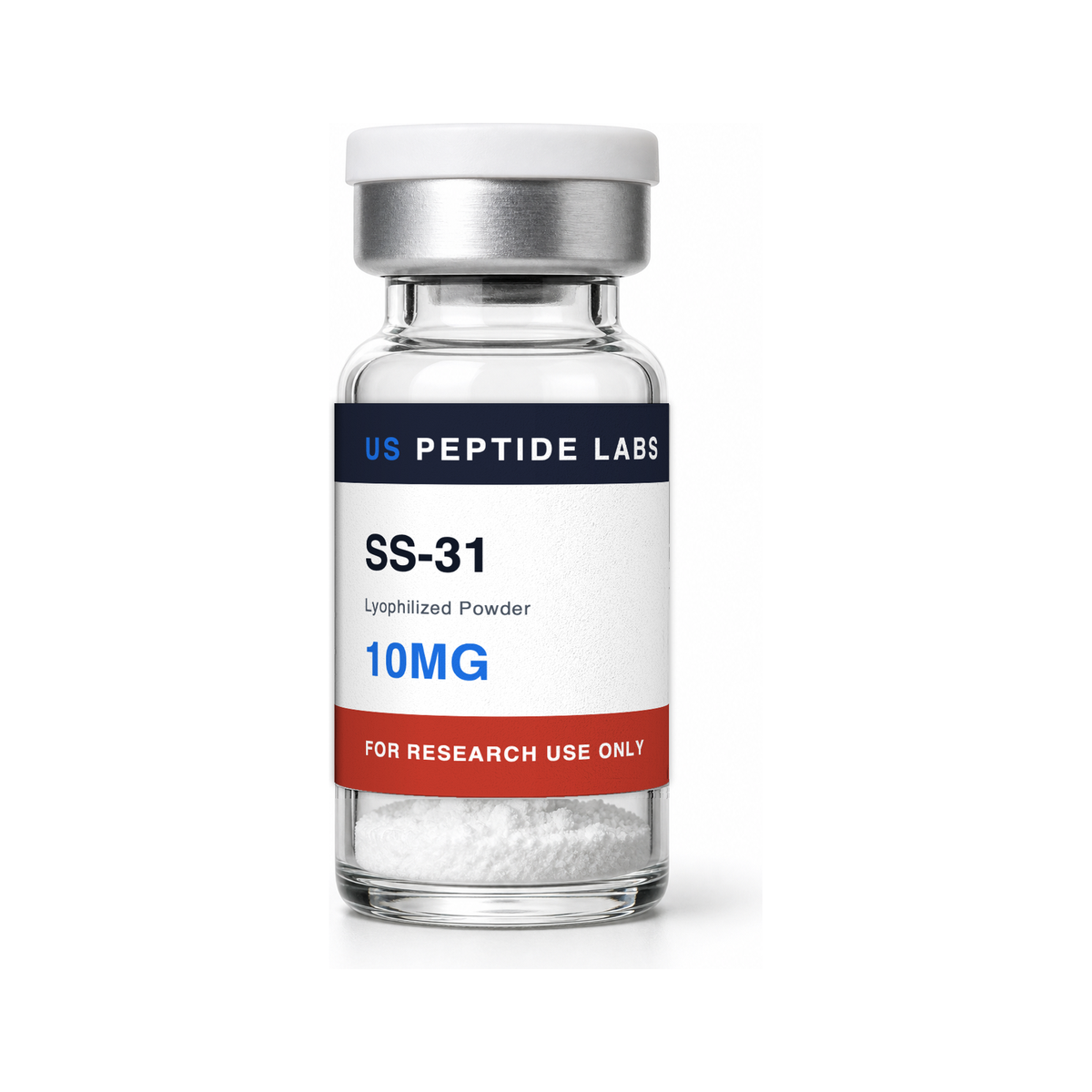
Vial products ship as dry lyophilized material unless the product format explicitly states otherwise.
10mL VialAnti-Aging & Longevity
10mL Vial
SS-31
Elamipretide — mitochondrial-targeted peptide
$60.00
Volume pricing
Per-unit price drops automatically as quantity increases.
| Strength | 1 | 2+ | 5+ |
|---|---|---|---|
| 10mg | $60.00 | $57.00 | $54.00 |
Per-unit pricing at each quantity break, applied automatically at checkout.
Elamipretide — mitochondrial-targeted peptide
Lot documentation
Certificate of Analysis
Lot-specific laboratory documentation for this product is available on request.
Request this lot’s COAWhat the literature reports
SS-31 (elamipretide) is a mitochondria-targeting tetrapeptide studied for cardiolipin interaction, oxidative injury models, and selected mitochondrial-disease clinical programs.
-
Mitochondria-targeted SS peptides inhibited mitochondrial swelling, oxidative cell death, and reperfusion injury in cellular and tissue assays.
-
In a rat renal ischemia-reperfusion model, SS-31 accelerated ATP recovery and reduced tubular injury markers after ischemia.
-
In the TAZPOWER program in Barth syndrome, longer-term elamipretide exposure was associated with changes in functional and cardiac imaging measures versus baseline extension assessments.
These summaries describe findings reported in published laboratory and clinical literature about this compound. They are provided for research context only. They are not claims about this product, and nothing here describes an intended use in humans or animals. This material is supplied strictly for laboratory research use.
Technical documentation
About SS-31
Technical overview
Mitochondria-targeting tetrapeptide (cardiolipin-binding)
SS-31, known clinically as elamipretide, is a small aromatic-cationic tetrapeptide designed to target the inner mitochondrial membrane. Foundational work showed high-affinity interaction with cardiolipin, protection of cristae architecture, and improved bioenergetics in ischemic and stressed mitochondria.
The molecule has progressed into multiple clinical research programs under the elamipretide name, including studies in primary mitochondrial disease, cardiac indications, Barth syndrome, and other mitochondria-linked conditions. Published doses in later subcutaneous programs commonly reference 40 mg daily in specific trial protocols, while earlier intravenous work used mg/kg/hour infusions. Parallel academic papers map its protein-interaction landscape and aging-mitochondria effects.
Educational dosage pages should prioritize peer-reviewed trial methods and mechanistic papers. Research-supply vials marketed as SS-31 are not automatically equivalent to clinical trial product. Keep research-use framing explicit and avoid disease-cure language.
Mechanism of action
SS-31 concentrates at the inner mitochondrial membrane through electrostatic and hydrophobic interaction with cardiolipin. Binding is reported to stabilize cristae, reduce cardiolipin peroxidation, improve electron-transport efficiency, and limit pathological reactive oxygen species generation. Cytochrome c peroxidase activity and apoptotic signaling cascades are among the downstream processes discussed in the literature. Net experimental readouts include preserved ATP production and improved organ function in ischemia-reperfusion and aging models.
Research applications
- mitochondrial bioenergetics
- ischemia-reperfusion models
- cardiolipin biology
- primary mitochondrial disease research
- cardiac and skeletal muscle energetics
- aging biology
Fields of active investigation, not claims. Investigation is not proof.
Mitochondrial medicine groups, cardiology research teams, and rare-disease investigators (including Barth syndrome programs) form the core audience. Basic scientists use SS-31 as a tool compound to probe cardiolipin-dependent membrane organization. This is a bioenergetics research community more than a cosmetic-peptide audience.
Amounts reported in the literature
What published research and laboratory protocols document. These describe what was studied — they are not instructions, recommendations, or a protocol for use.
| Reported amount | Frequency | Route | Research context |
|---|---|---|---|
| 4 mg – 40 mg | once daily | subcutaneous | Elamipretide clinical research programs using daily subcutaneous administration (trial-specific) |
| no single figure reported | infusion per protocol | intravenous | Early intravenous dose-escalation / infusion studies |
Handling and storage
Lyophilized research material: refrigerate or freeze per COA, protect from light. Reconstituted solutions: refrigerate, minimize agitation and freeze-thaw, and adhere to supplier or pharmacy beyond-use dating.
Notes on combined research
Clinical protocols study elamipretide as a targeted mitochondrial agent, sometimes on top of standard disease-specific care, not mixed into broad mito stacks with uncharacterized peptides. Academic comparisons may include other mitochondria-targeted antioxidants as separate arms. Avoid implying synergistic cure claims for combinations.
Analytical specifications
| Format | 10mL Vial |
|---|---|
| Physical form | Lyophilized powder |
| Also referred to as | Elamipretide, MTP-131, Bendavia, D-Arg-Dmt-Lys-Phe-NH2 |
| Reported half-life | On the order of hours in clinical pharmacology descriptions for elamipretide (route- and study-dependent; confirm in the specific PK publication) |
Identity and purity are documented per lot on the Certificate of Analysis for the material you receive. Lot, manufacture and expiry are stamped on the base of the vial or bottle.
Frequently asked questions
What is the dosage for SS-31 / elamipretide?
In several subcutaneous clinical research programs, 40 mg once daily is a prominently documented regimen. Earlier studies also tested lower SC amounts and IV mg/kg/hour infusions. Those numbers are trial doses for defined populations, not general self-administration guidance.
How much bac water for SS-31?
Match diluent to vial strength so that the intended mg dose is a measurable fraction of a milliliter. Example: 50 mg vial + 2 mL bac water = 25 mg/mL, so 1.6 mL approximates 40 mg. Plan concentration carefully for research pharmacy workflows.
SS-31 dosage per day
Daily subcutaneous dosing is the pattern used in multiple elamipretide programs. Community research vials sometimes discuss lower milligram amounts; distinguish those informal figures from peer-reviewed 40 mg daily protocols.
SS-31 dosage chart
Build charts from concentration (mg/mL) to mL drawn for target mg. Include a note separating clinical-trial 40 mg anchors from any lower research-catalog experiments. Unit confusion between mcg and mg is a common error with this compound.
How long does SS-31 take?
Trial durations span weeks to months depending on indication and endpoint (bioenergetic biomarkers versus clinical scales). Preclinical ischemia models can show acute mitochondrial effects. No single consumer timeline applies.
What is the half life of SS-31?
Elamipretide PK supports daily dosing in SC programs, implying a half-life measured in hours rather than days. Use the clinical pharmacology section of the relevant study for numeric values.
Can SS-31 be stacked?
Formal studies keep it as a focused mitochondrial intervention. Combining with other research peptides without a protocol adds noise. If co-interventions exist, they are usually standard-of-care medications defined by the disease under study.
References
Every reference below resolves to an indexed paper. We would rather cite less and cite accurately.
- The mitochondrial-targeted compound SS-31 re-energizes ischemic mitochondria by interacting with cardiolipin.
- First-in-class cardiolipin-protective compound as a therapeutic agent to restore mitochondrial bioenergetics.
- Mitochondrial protein interaction landscape of SS-31.
- Application research of novel peptide mitochondrial-targeted antioxidant SS-31 in mitigating mitochondrial dysfunction.
Research use only
For laboratory and research purposes only. Not for human consumption, veterinary use, or medical applications. This product is not a drug, food, supplement or cosmetic, is not approved by the FDA, and is not intended to diagnose, treat, cure or prevent any disease. This page summarises published scientific literature; it is not medical advice and not a recommendation to use this compound. All handling must be performed by qualified personnel in a controlled laboratory environment.
Made in America. Documented lot by lot.
Most peptides sold in this category are imported in bulk, repackaged, and sold with no paperwork attached to the material in the bottle. Ours are synthesized in United States laboratories and every lot carries its own certificate.
Where is this material made?+
In United States laboratories. We buy from domestic synthesis rather than importing finished bulk from an overseas supplier and relabeling it. That is the reason we are able to name a specific laboratory, lot and test date for what you receive.
Why does a US laboratory matter?+
A domestic supply chain is shorter and documented end to end: identifiable facilities operating under US laboratory practice, and paperwork that follows one specific lot instead of a generic product description. It also means shorter transit and no repackaging between the laboratory and the customer.
What documentation comes with a lot?
A lot-specific Certificate of Analysis from an independent laboratory. The lot number is stamped on the base of the container — match it against the certificates listed on this page, or scan the QR code on the label, to open the report for the exact material shipped.
Where does my order ship from?+
Our United States facility, packed and dispatched domestically with tracking. Orders do not transit customs or get repackaged en route.
Pairs well with.