Research Peptide
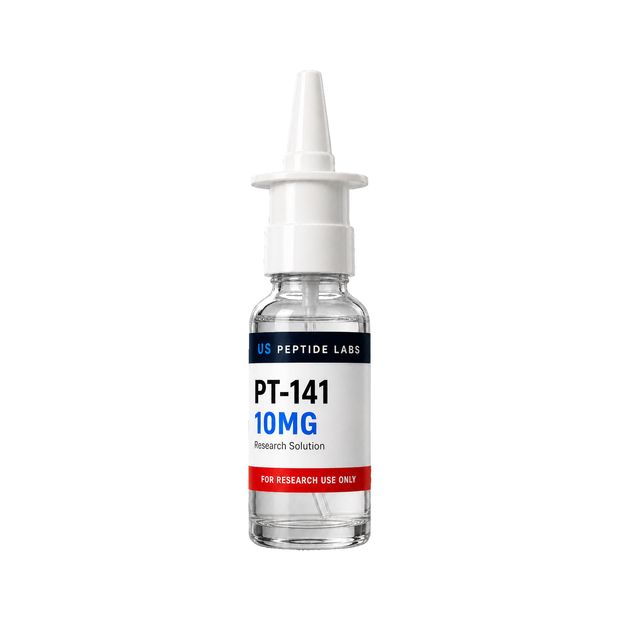
PT-141 Nasal Spray
PT-141 (Bremelanotide) — nasal spray formatThis listing supplies the compound as a pre-mixed...
$110.00
Vial products ship as dry lyophilized material unless the product format explicitly states otherwise.
Per-unit price drops automatically as quantity increases.
| Strength | 1 | 2+ | 5+ |
|---|---|---|---|
| 10mg | $110.00 | $104.50 | $99.00 |
Per-unit pricing at each quantity break, applied automatically at checkout.
Your lot number is stamped on the base of the vial or bottle. Match it to the list to open the certificate for the exact material you received.
Oxytocin is an endogenous nonapeptide hormone studied in human behavioral economics, parent-infant interaction physiology, and reproductive endocrinology.
In a double-blind trust-game experiment, intranasal oxytocin increased money transferred to trustees without altering non-social risk taking.
Maternal plasma oxytocin trajectories across pregnancy and the early postpartum period correlated with observed mother-infant bonding behaviors.
Parent-infant contact was associated with systematic rises in parental oxytocin alongside measures of behavioral synchrony.
These summaries describe findings reported in published laboratory and clinical literature about this compound. They are provided for research context only. They are not claims about this product, and nothing here describes an intended use in humans or animals. This material is supplied strictly for laboratory research use.
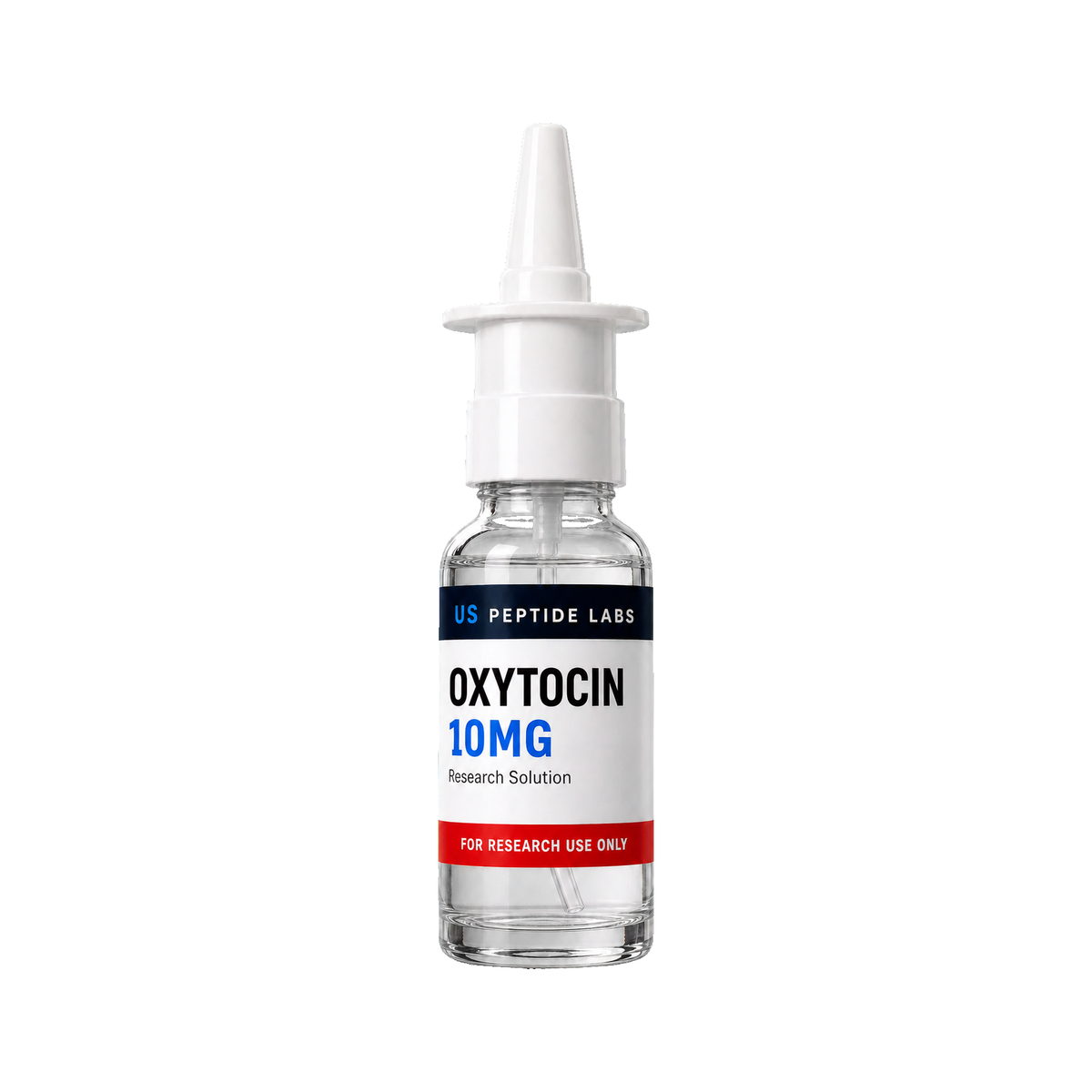
This listing supplies the compound as a pre-mixed nasal spray rather than a lyophilized vial, so no reconstitution step is required before use in a laboratory workflow. Intranasal delivery is studied as a non-injectable route that avoids first-pass hepatic metabolism; the published literature summarised below was generated across a range of administration routes, and route is one of the variables recorded in the reported-amounts table. Comparisons between routes are not equivalence claims — absorption differs by formulation and is documented per product, not inferred.
Because this nasal spray is supplied pre-prepared, the reconstitution arithmetic that applies to our lyophilized Oxytocin vials does not apply here: there is no diluent volume to choose and no concentration to derive. Store as labelled on the product, and consult the lot-matched Certificate of Analysis for the material you receive rather than generalising from a different format of the same compound.
Endogenous nonapeptide hormone
Oxytocin is an endogenous nonapeptide synthesized in the hypothalamus and released by the posterior pituitary. It is among the most thoroughly characterized peptides in human medicine because of long-standing obstetric uses, while a parallel research literature explores social cognition, stress responsivity, metabolic signals, and pain processing.
Pharmacologically, oxytocin is notable for a very short plasma half-life after intravenous dosing, which is why obstetric protocols often rely on controlled infusions. Research outside obstetrics frequently uses intranasal delivery when central nervous system questions are in view; subcutaneous routes appear in selected experimental pain and animal studies. A 2024 randomized trial reported that a low microgram-range subcutaneous dose modulated heat-pain ratings in healthy adults, adding a peer-reviewed SC data point.
Educational dosage content must separate approved obstetric regimens, intranasal social-neuroscience doses (often 24 IU in experimental paradigms), and research-peptide vial math. This page is research-and-education oriented with research-use-only framing for non-labeled contexts—not a guide for unsupervised hormone use.
Oxytocin binds the G protein-coupled oxytocin receptor (OXTR), expressed in uterus, mammary tissue, brain circuits, and peripheral sites. Receptor activation engages phospholipase C and calcium-dependent pathways that drive uterine smooth-muscle contraction and milk ejection in physiologic contexts. Centrally, OXTR signaling modulates social salience, anxiety-related circuits, and autonomic tone in experimental paradigms. Peripheral analgesic effects discussed in recent SC research may involve local receptor mechanisms in addition to any central actions.
Fields of active investigation, not claims. Investigation is not proof.
Obstetric clinical pharmacologists, affective and social neuroscientists, pain researchers, and endocrinology labs mapping OXTR distribution all work with oxytocin. Behavioral science groups dominate the intranasal literature. Peptide-education audiences often arrive via research-vial contexts and need help distinguishing IU obstetric dosing from mcg research vials.
What published research and laboratory protocols document. These describe what was studied — they are not instructions, recommendations, or a protocol for use.
| Reported amount | Frequency | Route | Research context |
|---|---|---|---|
| 4 mcg | single-dose experimental | subcutaneous | Experimental subcutaneous research (example peer-reviewed human SC study) |
| no single figure reported | study-defined (often single or limited repeated sessions) | intranasal | Common intranasal experimental neuroscience paradigms |
| 10 mcg – 100 mcg | varies widely in informal sources | subcutaneous | Secondary research-peptide discussions of SC ranges (less standardized than obstetric IV/IM labeling) |
Protect from heat and light; refrigerated storage is standard for oxytocin preparations. Reconstituted research solutions should be kept cold, tightly capped, and discarded per stability guidance. Oxytocin is oxidation- and temperature-sensitive relative to hardier lyophilized research peptides.
Neuroscience studies typically administer oxytocin alone when measuring social or stress endpoints. Combining with other neuropeptides confounds interpretation of OXTR-specific effects. Obstetric clinical protocols likewise do not stack research peptides; they follow labeled labor or postpartum pathways under medical supervision.
| Purity | ≥99.0% by HPLC |
|---|---|
| Physical form | See product format |
| Third-party laboratory | AxisPharm, LLC |
| Lots with COA on file | 1 |
| Also referred to as | OXT, OT, alpha-hypophamine |
| Reported half-life | About 1-6 minutes plasma half-life after IV administration commonly cited; effective central effects after intranasal dosing are discussed on longer behavioral timescales |
Identity and purity are documented per lot on the Certificate of Analysis for the material you receive. Lot, manufacture and expiry are stamped on the base of the vial or bottle.
What is the dosage for oxytocin peptide?
It depends entirely on context. Obstetric labeling uses IU for IV infusion or IM injection under clinical care. Social neuroscience often studies about 24 IU intranasally. A 2024 pain trial used 4 mcg subcutaneously as a single experimental dose. Research-vial mcg charts are not interchangeable with labor-and-delivery orders.
How much bac water for oxytocin?
For a 10 mg research vial, even 2-3 mL produces a very concentrated solution relative to low-mcg experimental targets, so serial dilution may be required for accurate microgram dosing. Document every dilution step. Clinical products arrive with their own diluents and concentrations.
Oxytocin dosage per day
There is no general per-day research standard analogous to once-weekly incretins. Obstetric use is continuous or event-driven. Behavioral studies are usually session-based. Chronic daily SC schedules online should be treated skeptically without primary support.
Oxytocin dosage chart
Separate charts by route: IU for labeled obstetric products, IU for intranasal experimental sprays, and mcg for reconstituted research vials. Include the conversion note that product-specific IU-mcg relationships must be confirmed on the label.
How long does oxytocin take?
IV obstetric effects on uterine tone can appear within minutes. Intranasal behavioral tasks are often timed 30-45 minutes after dosing in experimental protocols. SC analgesic endpoints in the 2024 trial were assessed in the post-injection experimental window defined by that study.
What is the half life of oxytocin?
Plasma half-life after IV dosing is commonly summarized around 1-6 minutes (sometimes cited near 3-5 minutes), which is why infusions are used clinically. Intranasal and SC kinetics differ; central behavioral effects are not identical to plasma half-life.
Can oxytocin be stacked with other peptides?
Controlled research almost always isolates oxytocin when OXTR questions matter. Stacking with other neuroendocrine peptides muddies receptor-level inference. Clinical obstetric care follows dedicated protocols, not peptide stacks.
How is oxytocin dosage calculated from a research vial?
Convert vial mg to mcg (1 mg = 1,000 mcg), divide by diluent mL to get mcg/mL, then multiply by mL drawn. Because target experimental mcg amounts can be tiny, use adequate dilution and a precision syringe. Cross-check with a dosage calculator and a second person when preparing research aliquots.
Every reference below resolves to an indexed paper. We would rather cite less and cite accurately.
For laboratory and research purposes only. Not for human consumption, veterinary use, or medical applications. This product is not a drug, food, supplement or cosmetic, is not approved by the FDA, and is not intended to diagnose, treat, cure or prevent any disease. This page summarises published scientific literature; it is not medical advice and not a recommendation to use this compound. All handling must be performed by qualified personnel in a controlled laboratory environment.
Most peptides sold in this category are imported in bulk, repackaged, and sold with no paperwork attached to the material in the bottle. Ours are synthesized in United States laboratories and every lot carries its own certificate.
PT-141 (Bremelanotide) — nasal spray formatThis listing supplies the compound as a pre-mixed...
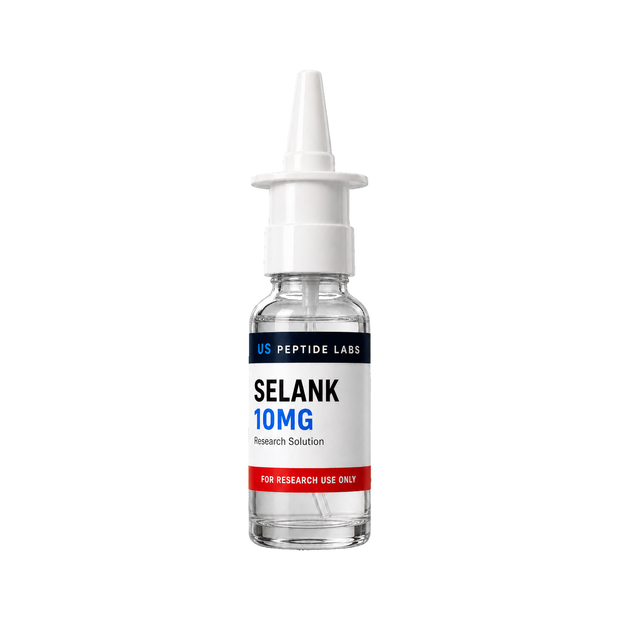
Selank — nasal spray formatThis listing supplies the compound as a pre-mixed nasal spray rat...