Research Peptide
PT-141 Nasal Spray
PT-141 (Bremelanotide) — nasal spray formatThis listing supplies the compound as a pre-mixed...
$110.00
Vial products ship as dry lyophilized material unless the product format explicitly states otherwise.
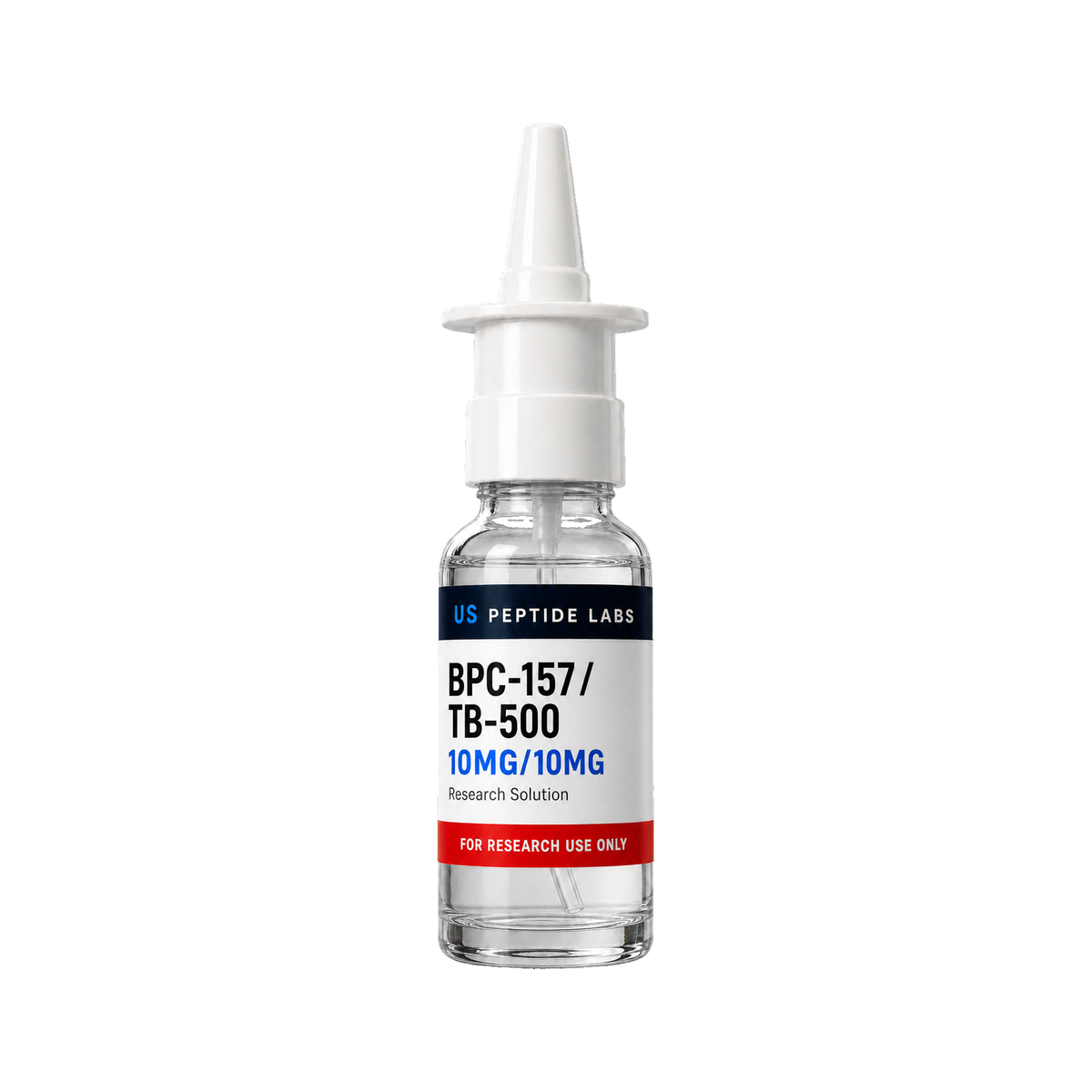
The Wolverine Stack — nasal research format
Per-unit price drops automatically as quantity increases.
| Strength | 1 | 2+ | 5+ |
|---|---|---|---|
| 10/10mg | $110.00 | $104.50 | $99.00 |
Per-unit pricing at each quantity break, applied automatically at checkout.
Your lot number is stamped on the base of the vial or bottle. Match it to the list to open the certificate for the exact material you received.
This research blend combines BPC-157 and thymosin beta-4–related sequences; published work largely examines each peptide separately in injury and repair laboratory models.
In tendon fibroblast systems, BPC-157 increased outgrowth, survival, and migration—endpoints relevant to soft-tissue repair research.
In a rat muscle crush-injury model, BPC-157 improved functional and histologic healing indices after gastrocnemius contusion.
In post-infarct mice, thymosin beta-4 enhanced cardiomyocyte survival and cardiac repair measures, illustrating regenerative endpoints studied for the TB-4 pathway.
These summaries describe findings reported in published laboratory and clinical literature about this compound. They are provided for research context only. They are not claims about this product, and nothing here describes an intended use in humans or animals. This material is supplied strictly for laboratory research use.
15mL Nasal Spray
This listing supplies the compound as a pre-mixed nasal spray rather than a lyophilized vial, so no reconstitution step is required before use in a laboratory workflow. Intranasal delivery is studied as a non-injectable route that avoids first-pass hepatic metabolism; the published literature summarised below was generated across a range of administration routes, and route is one of the variables recorded in the reported-amounts table. Comparisons between routes are not equivalence claims — absorption differs by formulation and is documented per product, not inferred.
Because this nasal spray is supplied pre-prepared, the reconstitution arithmetic that applies to our lyophilized BPC-157, TB-500 vials does not apply here: there is no diluent volume to choose and no concentration to derive. Store as labelled on the product, and consult the lot-matched Certificate of Analysis for the material you receive rather than generalising from a different format of the same compound.
BPC-157 / TB-500 Nasal Spray combines BPC-157 and TB-500. Each component is summarised below as it appears in the published literature.
synthetic gastric pentadecapeptide
BPC-157 is a 15-amino-acid peptide derived from a body-protection-compound sequence associated with gastric juice research. Most published work is preclinical, with animal models examining wound repair, tendon and ligament injury, gastrointestinal integrity, vascular responses, and nitric-oxide-system interactions. Human evidence is much thinner than internet discussion suggests.
Because the literature is dominated by rodent and other animal models, BPC-157 education needs careful framing. Research-grade BPC-157 is Research Use Only and is not an approved drug product. Reported ranges below reflect published animal-study exposure styles and should not be converted into human protocols.
Actin-binding repair peptide
TB-500 is a synthetic research peptide associated with the actin-binding region of thymosin beta-4 (Tβ4), a naturally occurring 43-amino-acid peptide abundant in platelets and wound fluid. In laboratory and preclinical models, Tβ4 and related fragments have been examined for roles in cell motility, angiogenesis, inflammation resolution, and extracellular-matrix organization after injury.
Researchers study TB-500 because full-length Tβ4 has a long experimental record in dermal wound models, cardiac injury paradigms, corneal repair work, and regenerative-biology reviews. The synthetic fragment is used as a more practical research tool when investigators want to probe actin-cytoskeleton and repair-associated signaling without working with the entire native protein.
All material discussed here is Research Use Only (RUO). It is not a drug product, not approved by the FDA for human use, and not intended for human consumption, clinical treatment, or diagnostic procedures. Published dosage figures below are literature or commonly cited research-protocol references, not recommendations.
BPC-157 is studied for interactions with cytoprotective pathways, angiogenesis-related signaling, nitric oxide balance, and tissue-response networks. Preclinical papers describe effects on vascular integrity, growth-factor expression, inflammatory responses, and gastrointestinal mucosal resilience. The exact receptor-level mechanism is not settled, and much of the evidence comes from model-specific injury systems. That uncertainty is why species, route, and endpoint matter so much in BPC-157 interpretation.
Thymosin beta-4 sequesters G-actin and helps regulate actin polymerization, which influences cytoskeletal remodeling and cell migration. Related domains have been linked in the literature to pro-angiogenic signaling, reduced inflammatory tone at injury sites, and shifts in fibrosis-related cell phenotypes. TB-500 is studied as a compact surrogate for key actin-binding and repair-associated activities of the parent peptide, though fragment-versus-full-length differences remain an active research question.
Fields of active investigation, not claims. Investigation is not proof.
BPC-157 is studied mainly by preclinical pharmacology groups, gastrointestinal researchers, sports-medicine reviewers, and analytical laboratories. Human clinical researchers generally treat the evidence base as preliminary and not interchangeable with approved peptide therapeutics.
Interest is highest among regenerative-biology, sports-medicine research, and wound-healing laboratories that model soft-tissue injury, angiogenesis, or cytoskeletal control of repair. Comparative work also appears in cardiac and corneal injury literature focused on Tβ4 biology rather than TB-500 as a clinical agent.
What published research and laboratory protocols document. These describe what was studied — they are not instructions, recommendations, or a protocol for use.
| Component | Reported amount | Frequency | Route | Research context |
|---|---|---|---|---|
| BPC-157 | 0.01 mcg – 10 mcg | varies by animal model | intraperitoneal, oral, topical, or local in animal studies | Preclinical BPC-157 animal studies frequently report ng/kg to mcg/kg exposure bands |
| BPC-157 | 10 mcg | model-dependent | animal-study routes vary | Rodent injury and gastrointestinal models often cite 10 mcg/kg as an experimental exposure |
| TB-500 | 2 mg – 5 mg | twice weekly | subcutaneous | Commonly cited in research-protocol summaries for synthetic TB-500 |
| TB-500 | 2 mg – 2.5 mg | once weekly | subcutaneous | Maintenance-style ranges reported in research-community protocols |
| TB-500 | 42 mg – 1260 mg | single or daily multi-dose cohorts | intravenous | Human intravenous Tβ4 safety study (full-length peptide, not TB-500 fragment) |
Lyophilized BPC-157 is commonly stored frozen or refrigerated, dry, and protected from light; reconstituted research solutions are usually refrigerated and handled aseptically.
Keep lyophilized vials refrigerated or frozen, protected from light and moisture. After reconstitution with bacteriostatic water, refrigerate and use within the timeframe specified by the laboratory protocol, typically days to a few weeks.
BPC-157 is commonly paired in online discussion with TB-500, GHK-Cu, or recovery-focused compounds, but those combinations outrun the human evidence. Research protocols should isolate injury model, route, and endpoint before combining peptides, especially when the base evidence is preclinical.
In research discussions, TB-500 is frequently examined alongside BPC-157 because both appear in soft-tissue repair literature, though through different proposed pathways. Some protocols also pair actin-repair work with growth-hormone secretagogue or GHRH-analog models when the experimental question involves recovery physiology rather than a single molecular target.
| Purity | ≥99.0% by HPLC |
|---|---|
| Format | 15mL Nasal Spray |
| Physical form | See product format |
| Third-party laboratory | AxisPharm, LLC |
| Lots with COA on file | 1 |
| Also referred to as | Body Protection Compound 157, PL 14736, stable gastric pentadecapeptide BPC 157, Thymosin Beta-4 fragment, Tβ4 fragment, LKKTETQ motif peptide |
| Reported half-life | BPC-157: Not well established for human use; published discussions emphasize stability in gastric-juice-related contexts and model-specific exposure rather than a clinical half-life. — TB-500: ~2-3 hours reported for related Tβ4 biology; tissue effects may outlast plasma half-life |
Identity and purity are documented per lot on the Certificate of Analysis for the material you receive. Lot, manufacture and expiry are stamped on the base of the vial or bottle.
BPC-157: what is the dosage for BPC-157
Published BPC-157 research is mostly animal work, often reported as ng/kg or mcg/kg. Those values are reference information and are not human dosing instructions.
TB-500: What is TB-500 peptide dosage in research contexts?
Secondary research summaries most often cite about 2,000-5,000 mcg twice weekly during higher-intensity phases, with lower once-weekly amounts afterward. These are reference figures from protocol literature, not medical advice.
BPC-157: how much bacteriostatic water for BPC-157
Common research examples use 1-3 mL for 5-10 mg vials. Reconstitution volume changes concentration only.
TB-500: Is TB-500 the same as thymosin beta-4?
Not exactly. TB-500 is a synthetic peptide related to the actin-binding region of thymosin beta-4. Full-length Tβ4 is the native 43-amino-acid peptide used in many primary papers.
BPC-157: BPC-157 dosage per day
Daily BPC-157 schedules in online charts are not the same as published study protocols. A literature-based answer must specify species, route, and model.
TB-500: How is TB-500 typically reconstituted for lab use?
Research vials of 5-10 mg are commonly reconstituted with 2-3 mL bacteriostatic water so insulin-syringe graduations map cleanly to mcg amounts. Exact solvent volume depends on the assay design.
BPC-157: BPC-157 dosage chart
A responsible chart should separate animal-study mcg/kg values from vial concentration math and should avoid presenting either as a recommendation.
TB-500: What pathways make TB-500 interesting to researchers?
Most interest centers on actin sequestration, cell migration, angiogenesis, and inflammation-resolution signaling observed with Tβ4-family peptides in injury models.
Every reference below resolves to an indexed paper. We would rather cite less and cite accurately.
For laboratory and research purposes only. Not for human consumption, veterinary use, or medical applications. This product is not a drug, food, supplement or cosmetic, is not approved by the FDA, and is not intended to diagnose, treat, cure or prevent any disease. This page summarises published scientific literature; it is not medical advice and not a recommendation to use this compound. All handling must be performed by qualified personnel in a controlled laboratory environment.
Most peptides sold in this category are imported in bulk, repackaged, and sold with no paperwork attached to the material in the bottle. Ours are synthesized in United States laboratories and every lot carries its own certificate.
PT-141 (Bremelanotide) — nasal spray formatThis listing supplies the compound as a pre-mixed...
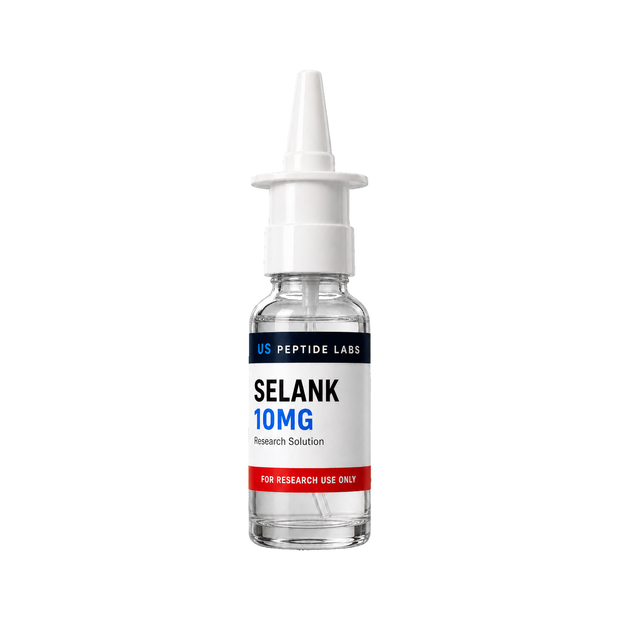
Selank — nasal spray formatThis listing supplies the compound as a pre-mixed nasal spray rat...