Peptide profile / Research use only
GHK-Cu Peptide
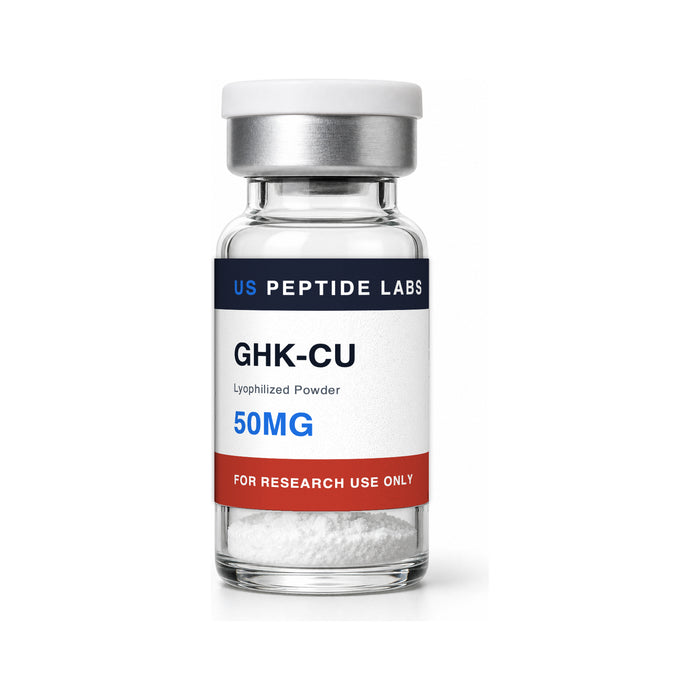
GHK-Cu in stock
GHK-Cu is not an FDA approved drug, and its use in pharmacy compounding is under FDA review. It is allowed as a cosmetic ingredient, which is a different category from the research material on this page. See Is GHK-Cu FDA approved?
The blue colour of the powder and of the solution comes from the copper. A blue vial is normal for GHK-Cu. We explain it in Why is GHK-Cu blue?
GHK-Cu at a glance
Where GHK-Cu comes from
GHK was isolated from human plasma in 1973 by Loren Pickart, who was studying why plasma from younger donors made old liver cells behave more like young ones. The active factor turned out to be a three amino acid peptide with a strong pull on copper.
Reviews by the same author report a plasma level of about 200 ng/mL at age 20 that falls to about 80 ng/mL by age 60. That decline is the reason the peptide appears so often in ageing research. See Why do GHK-Cu levels decline with age?
In our catalog it sits in the Anti-Aging and Longevity category.
Copper binding tripeptide, 3 amino acids. Supplied as a freeze-dried powder for laboratory research.
See the formats in stockWhat research on GHK-Cu looks at
Skin and collagen studies
Reviews by Pickart and colleagues summarise decades of in vitro and animal work on collagen synthesis, wound models and skin remodelling.
Gene expression
Analyses based on the Broad Institute Connectivity Map report that GHK changes the expression of a large share of human genes in cell data.
Copper binding
The peptide has a strong affinity for copper(II), and most authors link its activity to the GHK-Cu complex.
Wound models
Reviews summarise wound studies in several animal species, with faster closure and more collagen in treated tissue.
Cosmetic use and research material
GHK-Cu is a common cosmetic ingredient, listed on labels as Copper Tripeptide-1. The vial sold here is a research material and not a cosmetic product. More in Is GHK-Cu the same as copper peptides in skincare?
Much of the gene expression work is computer analysis of cell data. It shows which genes change, not what that means in a living body.
This page summarises published laboratory research. It is not medical advice, and the product is not for human or veterinary use.
Sources
GHK-Cu formats in the catalog
| Product | Format | What is inside | Price |
|---|---|---|---|
| GHK-Cu | Freeze-dried powder in a vial | One compound | $60.00 |
| GHK-Cu Nasal Spray | Nasal spray bottle | One compound | $110.00 |
| KLOW (BPC-157 / GHK-Cu / TB-500 / KPV) Blend | Freeze-dried powder in a vial | Blend of several compounds | $145.00 |
A single compound vial is the simplest material to work with, because the certificate covers one peptide. In a blend, the label and the certificate list the amount of each compound separately. All formats are in the full catalog.
GHK-Cu compared with BPC-157 and TB-500
| GHK-Cu | BPC-157 | TB-500 | |
|---|---|---|---|
| Length | 3 amino acids with copper | 15 amino acids | 7 or 43 amino acids, depending on the form |
| Origin of the sequence | Fragment found in human plasma | Partial sequence of a gastric juice protein | Thymosin beta-4 |
| Main research area | Skin, collagen and gene expression studies | Tendon, ligament and gut tissue models | Actin binding, cell migration, wound models |
How to read the certificate of analysis for GHK-Cu
Every lot is tested by an independent lab. These four lines on the certificate of analysis tell you what is in the vial. All current certificates are on the Quality and COAs page.
Lot number
It has to match the number printed on your vial. If it does not, you are reading the wrong certificate.
Identity
Mass spectrometry gives the measured molecular weight. It should match the weight of GHK-Cu.
Purity
HPLC shows how much of the sample is the target peptide, as a percentage of the main peak.
Amount
The measured fill per vial. Use this figure, not the rounded number on the label, when you record a concentration.
Storage and handling of GHK-Cu in the lab
Keep the freeze-dried powder cold, dry and away from light, as the label says. See Do peptides need to be refrigerated?
Let the vial reach room temperature first. Add the diluent slowly down the glass wall and swirl. Do not shake. The steps are in How do you reconstitute peptides?
Keep the solution refrigerated. Write the concentration and the date on the vial.
Short answers about GHK-Cu
Related peptides
 Vial
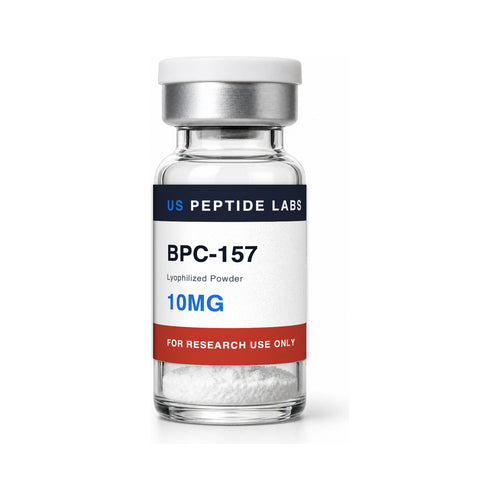 Vial and spray
 Vial
 Vial and spray
 Vial and spray
GHK-Cu FAQ
What is GHK-Cu?
GHK-Cu is the copper complex of the tripeptide glycyl-L-histidyl-L-lysine.
What does GHK stand for?
The one-letter codes of its three amino acids: glycine (G), histidine (H) and lysine (K).
Where does GHK occur naturally?
In human plasma, saliva and urine. Reviews report that plasma levels decline with age.
Why is the powder blue?
The copper(II) in the complex gives GHK-Cu its blue colour.
Is GHK-Cu approved for human use?
The material sold here is for laboratory research use only.
How is GHK-Cu supplied?
As a lyophilized powder in a sealed vial, with the amount per vial on the label.
How should the vial be stored?
Keep lyophilized vials cold, dry and away from light.
Where can I see the certificate of analysis?
Scan the QR code on the vial or open the Quality and COAs page.
All products are sold for laboratory research use only. Not for human or veterinary use.