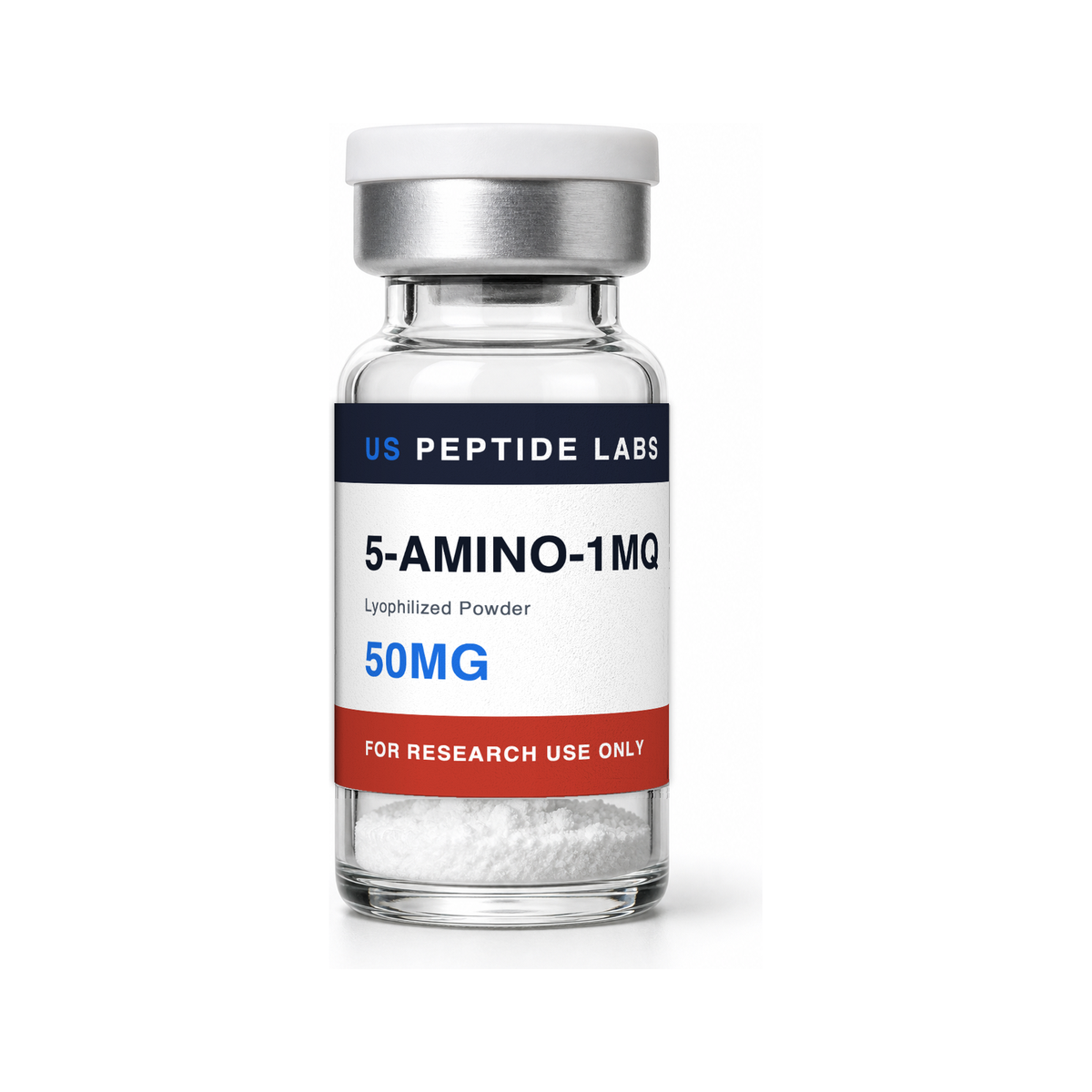
Vial products ship as dry lyophilized material unless the product format explicitly states otherwise.
10mL Vial99%+ PurityPerformance & Vitality
10mL Vial
5-Amino-1MQ
NNMT inhibitor — metabolic research compound
$62.00
Volume pricing
Per-unit price drops automatically as quantity increases.
| Strength | 1 | 2+ | 5+ |
|---|---|---|---|
| 50mg | $62.00 | $58.90 | $55.80 |
Per-unit pricing at each quantity break, applied automatically at checkout.
NNMT inhibitor — metabolic research compound
Lot documentation
Certificate of Analysis
Your lot number is stamped on the base of the vial or bottle. Match it to the list to open the certificate for the exact material you received.
- Lots on file
- 1
- Laboratory
- AxisPharm, LLC
What the literature reports
5-Amino-1MQ is a small-molecule nicotinamide N-methyltransferase (NNMT) inhibitor studied in diet-induced obese mouse models of adiposity and energy expenditure.
-
In high-fat-diet mice, systemic 5-amino-1MQ reduced body weight, white adipose mass, adipocyte size, and plasma total cholesterol without lowering food intake.
-
In diet-induced obese mice switched to a reduced-calorie diet, NNMT inhibition with 5-amino-1MQ enhanced fat-mass loss and altered gut microbiome composition.
-
Mechanistic characterization identified 5-amino-1MQ as a selective, membrane-permeable NNMT inhibitor suitable for in vivo metabolic studies.
These summaries describe findings reported in published laboratory and clinical literature about this compound. They are provided for research context only. They are not claims about this product, and nothing here describes an intended use in humans or animals. This material is supplied strictly for laboratory research use.
Technical documentation
About 5-Amino-1MQ
Technical overview
Small-molecule NNMT inhibitor (not a classical peptide)
5-Amino-1MQ is a small-molecule inhibitor of nicotinamide N-methyltransferase (NNMT), not a peptide chain. It appears on peptide-education sites because the same research audiences shop metabolic compounds together, but chemically it is a methylquinolinium tool compound.
Peer-reviewed work is primarily preclinical. In diet-induced obese mice, NNMT inhibition with 5-Amino-1MQ reduced adiposity and altered metabolic markers without requiring reduced food intake in key experiments. Follow-up studies combined NNMT inhibition with dietary change and examined microbiome and fat-mass endpoints.
There are no robust published human clinical dosage trials on PubMed comparable to approved metabolic drugs. Online capsule strengths are commercial research-chemical practices, not validated therapeutic regimens. Frame everything as laboratory reference information.
Mechanism of action
NNMT methylates nicotinamide to 1-methylnicotinamide, influencing the NAD+ salvage pathway and methyl-donor balance. Inhibiting NNMT can raise NAD+ and SAM-related metabolic tone in adipose and other tissues in experimental systems. 5-Amino-1MQ is described as membrane-permeable and relatively selective versus several related methyltransferases, which is why it became a preferred in vivo NNMT tool compound.
Research applications
- obesity and adipose biology
- NAD+ metabolism
- NNMT enzymology
- diet-drug combination metabolic research
- microbiome-metabolism interactions
Fields of active investigation, not claims. Investigation is not proof.
Metabolic disease labs, adipose biologists, and NAD+-pathway chemists are the core users. Longevity and body-composition research communities amplified interest after the mouse papers, which is why dosage queries spiked despite the thin human evidence base.
Amounts reported in the literature
What published research and laboratory protocols document. These describe what was studied — they are not instructions, recommendations, or a protocol for use.
| Reported amount | Frequency | Route | Research context |
|---|---|---|---|
| 20 mg | three times daily (≈60 mg/kg/day total) | subcutaneous (preclinical) | Diet-induced obese mouse study (Neelakantan et al.) |
| 32 mg | once daily | subcutaneous (preclinical) | Follow-up DIO mouse work (Dimet-Wiley et al.) |
Handling and storage
As a solid small molecule, store cool, dry, and light-protected in a tightly closed container. If a lab prepares a solution for animal work, follow solvent-specific stability (often aliquoted frozen); oral research capsules are kept sealed at controlled room temperature or per COA.
Notes on combined research
Published stacking of true interest is with dietary intervention (calorie/composition change), not with random peptide cocktails. Mechanistic neighbors include other NAD+-pathway tools (for example NMN/NR research) and separate obesity agents, but combining them is a hypothesis generator rather than a validated protocol.
Analytical specifications
| Purity | ≥99.6% by HPLC |
|---|---|
| Format | 10mL Vial |
| Physical form | Lyophilized powder |
| Third-party laboratory | AxisPharm, LLC |
| Lots with COA on file | 1 |
| Also referred to as | 5-amino-1-methylquinolinium, 5A-1MQ, NNMTi, 5-amino-1-methylquinolinium iodide |
| Reported half-life | Short plasma window in mouse PK notes (rapid absorption; hours-scale coverage above IC50 reported in related profiling) |
Identity and purity are documented per lot on the Certificate of Analysis for the material you receive. Lot, manufacture and expiry are stamped on the base of the vial or bottle.
Frequently asked questions
What is the dosage for 5-Amino-1MQ?
Peer-reviewed dosages are mouse doses such as 20 mg/kg SC three times daily or 32 mg/kg SC once daily. Human clinical dose-finding trials are not established in the same literature set. Commercial capsule sizes should not be confused with proven therapeutic doses.
How much BAC water for 5-Amino-1MQ?
Usually not applicable. This compound is typically an oral research solid/capsule or a solvent-dissolved animal-study preparation, not a bacteriostatic-water peptide reconstitution problem.
5-Amino-1MQ dosage per day?
In mice, total daily exposure in the flagship study was on the order of 60 mg/kg/day split t.i.d. That does not translate to a responsible human daily recommendation on an education page.
5-Amino-1MQ dosage chart?
A research chart should list species, route, mg/kg, and duration from primary papers. Charts that only show human capsule counts without citing clinical data overstate certainty.
What is 5-Amino-1MQ half life?
Mouse pharmacokinetic profiling suggests rapid absorption and multi-hour presence above inhibitory concentrations after SC dosing; exact human half-life is not well established in peer-reviewed clinical PK papers.
Can 5-Amino-1MQ be stacked?
The best-supported experimental 'stack' is with dietary modification in obese mouse models. Peptide stacking claims are mostly speculative and outside strong published evidence.
Is 5-Amino-1MQ a peptide?
No. It is a small-molecule NNMT inhibitor. It is grouped with metabolic research compounds in commerce, which creates the naming confusion.
Why is it often sold as capsules?
Because it is a small molecule suited to oral solid handling in research-chemical markets. Note that key efficacy papers still relied on parenteral dosing in mice due to bioavailability considerations in that species.
References
Every reference below resolves to an indexed paper. We would rather cite less and cite accurately.
- Selective and membrane-permeable small molecule inhibitors of nicotinamide N-methyltransferase reverse high fat diet-induced obesity in mice.
- Reduced calorie diet combined with NNMT inhibition establishes a distinct microbiome in DIO mice.
Research use only
For laboratory and research purposes only. Not for human consumption, veterinary use, or medical applications. This product is not a drug, food, supplement or cosmetic, is not approved by the FDA, and is not intended to diagnose, treat, cure or prevent any disease. This page summarises published scientific literature; it is not medical advice and not a recommendation to use this compound. All handling must be performed by qualified personnel in a controlled laboratory environment.
Made in America. Documented lot by lot.
Most peptides sold in this category are imported in bulk, repackaged, and sold with no paperwork attached to the material in the bottle. Ours are synthesized in United States laboratories and every lot carries its own certificate.
Where is this material made?+
In United States laboratories. We buy from domestic synthesis rather than importing finished bulk from an overseas supplier and relabeling it. That is the reason we are able to name a specific laboratory, lot and test date for what you receive.
Why does a US laboratory matter?+
A domestic supply chain is shorter and documented end to end: identifiable facilities operating under US laboratory practice, and paperwork that follows one specific lot instead of a generic product description. It also means shorter transit and no repackaging between the laboratory and the customer.
What documentation comes with a lot?
A lot-specific Certificate of Analysis from an independent laboratory. The lot number is stamped on the base of the container — match it against the certificates listed on this page, or scan the QR code on the label, to open the report for the exact material shipped.
Where does my order ship from?+
Our United States facility, packed and dispatched domestically with tracking. Orders do not transit customs or get repackaged en route.
Pairs well with.
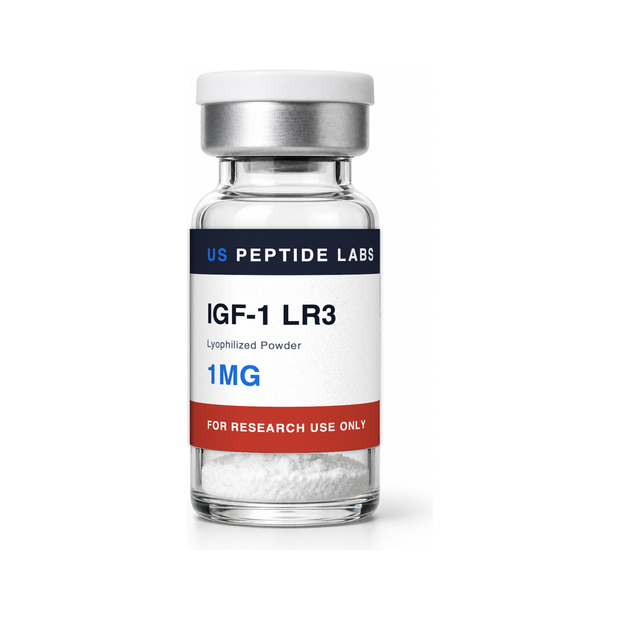
Research Peptide
IGF-1 LR3
IGF-1 LR3 supplied as lyophilized powder in a 10 mL vial for laboratory research use only. E...
$140.00